

A vendor neutral consultant for ERP selection is an adviser who helps you choose an ERP without earning anything from the product you pick. They compare options objectively using a weighted scoring model, scripted demos run on your own data, independent reference checks and a full total cost of ownership. The result is a decision your leadership can explain and defend. This guide sets out that framework step by step, so you can run it yourself or judge whether an adviser is doing it properly. Upturnist offers this kind of independent technology consulting for UAE businesses.
Key Takeaways
- A vendor neutral consultant for ERP selection fixes the criteria and weights before any demo, so the decision is not led by the best presentation.
- A true vendor neutral ERP consulting firm discloses every commercial tie and lets your data, your users and your costs decide.
- Many ERP consulting companies resell software, so ask how each adviser is paid before you hire one.
What a Vendor Neutral Consultant for ERP Selection Actually Does
An independent adviser runs a structured process that turns opinions into evidence. A vendor neutral consultant for ERP selection documents your requirements, builds the scoring model, manages demos and reference calls, and calculates long term cost. They have no stake in the outcome, so every recommendation can be traced back to your own criteria.
Independence is easy to claim and harder to prove. Ask three questions. Does the adviser earn resale margin, referral fees or licence commission from any product on the shortlist? Will they bid to implement the system they recommend? Can they show past selections that ended with different products? A vendor neutral ERP consulting firm should answer all three openly and in writing.
Timing matters as well. The best moment to bring in an adviser is before you speak to suppliers, not after a favourite has emerged. Early involvement lets the adviser shape the requirements, the long list and the timeline. Late involvement often turns the adviser into a referee for a decision that has already been made informally.
The adviser also protects the process from internal bias. Departments often arrive with a favourite system already in mind. A good consultant gives every stakeholder a voice in the criteria, then holds everyone to the same scorecard. Before any of this, the adviser should understand how the business runs today. A business process assessment often comes first, because requirements written on top of broken processes simply automate the problems.
Build a Weighted Scoring Model Before Any Demo
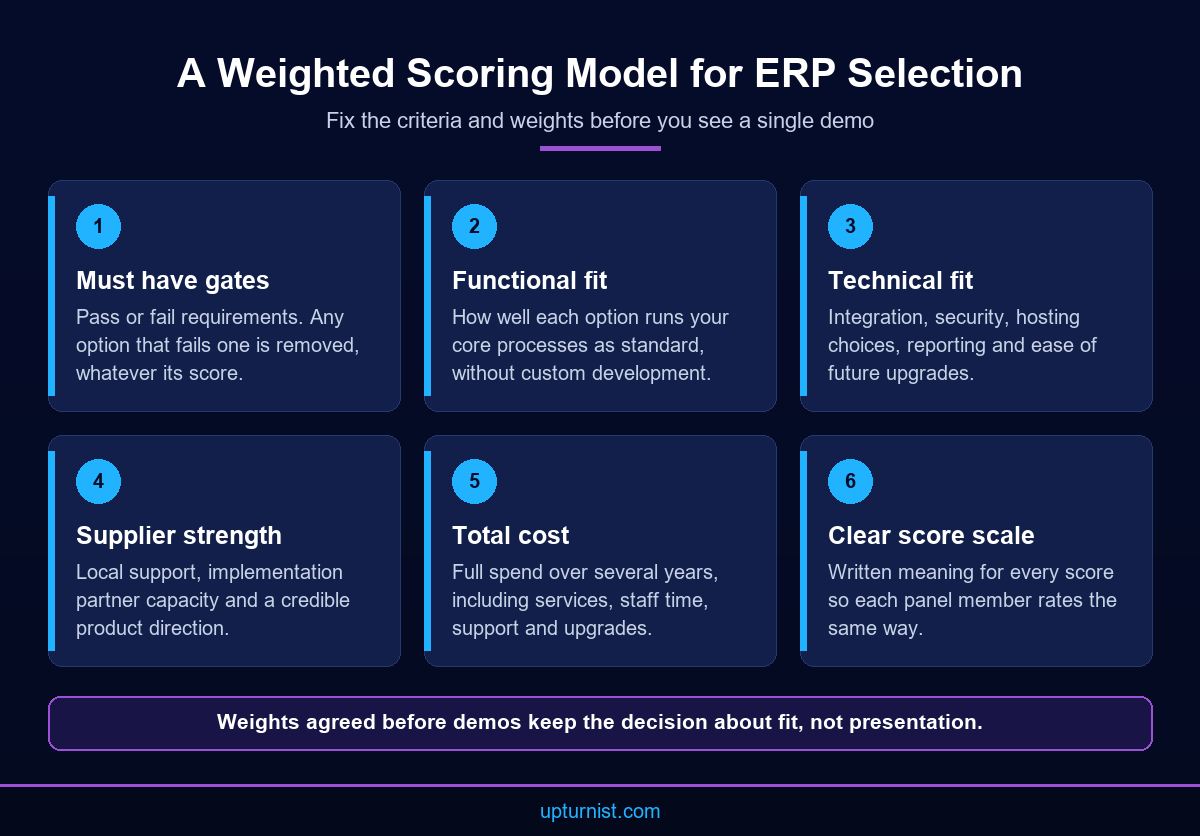
The scoring model is the heart of an objective selection. Agree the criteria, their weights and the scoring scale before you see a single product. This follows the logic of multiple criteria decision analysis. Once demos start, weights tend to drift towards whatever impressed people most on the day.
Group the criteria into a few clear areas. Functional fit covers how well each option handles your core processes. Technical fit covers integration, security, hosting and reporting. Supplier strength covers local support, partner capacity and product direction. Cost covers the full spend over several years, not just licences.
Give each area a weight that reflects your priorities, with the total adding up to one hundred. Then define what each score means. A score of five might mean the process works as standard, while a score of one means it needs custom development. Clear definitions stop scorers from guessing. A vendor neutral consultant for ERP selection should also separate must have items from scored items. Any option that fails a must have is removed, whatever its total.
Run Scripted Demos With Your Own Data
Open demos show what a product does best. Scripted demos show how it handles your business. Write short scenarios from your real processes, send them to every shortlisted supplier with sample data, and ask each one to follow the same script. Everyone on the panel scores the same steps on the same sheet.
Good scripts follow a full business flow rather than isolated features. For example, take a real customer order through pricing, approval, purchasing, receipt, delivery, invoicing and month end reporting. Include an awkward case, such as a partial delivery or a credit note. Ask the supplier to show the steps live, not on slides.
Invite the people who will use the system every day, not only managers. A storekeeper or accountant will spot problems that leadership misses. Collect scores on the day, before people talk each other round. Ask scorers to write a short reason next to any very high or very low score. Those notes help settle disagreements later and show whether a score reflects the product or the presenter. Keep the same panel for every demo where you can. Your process documents help here too. Clear procedures from SOP development work make it much easier to write demo scripts that reflect how your teams really operate.
Check References and Total Cost of Ownership
Reference checks and cost analysis test what the demo cannot. Speak to customers similar to you in size, industry and complexity, ideally ones you find yourself. Then calculate the total cost of ownership over several years, because licence price alone rarely decides which option is cheaper.
On reference calls, ask specific questions. How long did go live really take compared with the plan? What did you have to customise? How responsive is local support? What would you do differently? Ask to speak to a finance user and an operations user, not only the project sponsor.
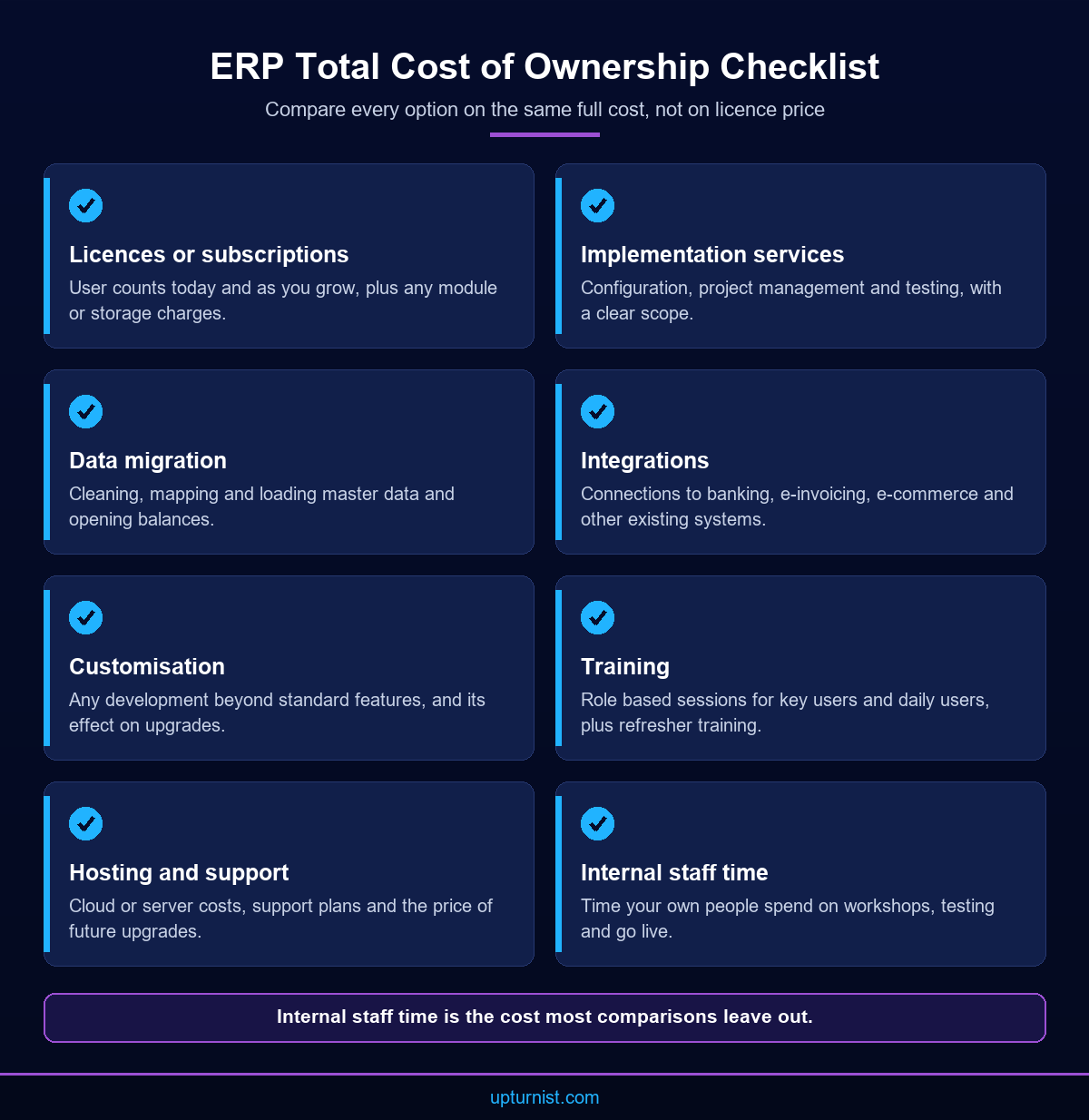
For cost, include licences or subscriptions, implementation services, data migration, integrations, customisation, training, hosting, support and upgrades. Add your own staff time, which is often the largest hidden cost. A vendor neutral consultant for ERP selection should build this model in the same format for every option, so the comparison is fair.
Watch for warning signs in proposals. Vague implementation scope, unpriced integrations and optimistic timelines usually return later as change requests. Ask every supplier to state their assumptions clearly. Where assumptions differ, adjust the cost model so each option is priced for the same scope.
Make the Decision and Write It Down
The final step turns scores into a decision leadership can stand behind. Combine the weighted scores, reference findings and cost model in one summary. Then test how stable the result is. If a small change in weights flips the winner, discuss that openly before you sign anything.
Hold a decision workshop with the steering group. Walk through the scorecard, the risks of each option and the cost over time. Record the reasons for the choice and the conditions attached to it, such as named consultants, fixed scope or performance terms. Carry those conditions into the contract.
Share the outcome with the wider team, including the reasons behind it. People accept a new system more readily when they can see their input in the scorecard. Thank the suppliers who were not chosen and give brief feedback. A fair, transparent process also keeps those relationships useful if you need them later.
Finally, keep the scorecard. It becomes the baseline for implementation. If the chosen product cannot deliver a scored requirement, you have written evidence to raise it early. Upturnist’s strategy and roadmap support can link the ERP decision to wider business priorities, so the system serves the plan rather than driving it.
Conclusion
Objective ERP selection is a method, not a feeling. Fix weighted criteria first, run scripted demos on your own data, check references you choose yourself and compare total cost over several years. A vendor neutral consultant for ERP selection makes that method stick and keeps every voice inside the same scorecard. Upturnist is a business transformation consultancy that works business first, process second and technology third. If you want a clear, defensible ERP choice that helps you improve the way you operate, talk to our consultants about your selection.
Frequently Asked Questions
What does a vendor neutral consultant for ERP selection do?
They help you choose an ERP without any financial interest in the result. They document requirements, build a weighted scoring model, run scripted demos, check references and compare total cost, then recommend the option that best fits your criteria.
How do I know if an ERP adviser is truly independent?
Ask whether they earn resale margin, referral fees or commission from any shortlisted product, and whether they will bid to implement it. A truly independent adviser answers in writing and can show selections that ended with different products.
What criteria should an ERP scoring model include?
Most models cover functional fit, technical fit, supplier strength and total cost. Weight each area by business priority before demos start. Separate must have items, which remove an option if failed, from scored items that rank the remaining options.
What is a scripted ERP demo?
It is a demonstration where every supplier follows the same business scenarios using your sample data. Your team scores each step on one sheet. This makes options directly comparable and exposes gaps that open, supplier led demos usually hide.
Why is total cost of ownership better than comparing licence prices?
Licences are only part of the spend. Implementation, migration, integration, training, hosting, support, upgrades and internal staff time often cost more over several years. Comparing the full cost shows which option is really affordable for your business.
How many ERP options should we shortlist?
Most businesses shortlist a small number, often two to four, after an initial screen against must have requirements. Fewer options allow deeper scripted demos and reference checks, which produce a better decision than shallow reviews of many products.
Who should sit on the ERP selection panel?
Include a sponsor from leadership, process owners from finance, operations and sales, and a few daily users such as storekeepers or accountants. IT should cover integration and security. Everyone scores against the same sheet to keep the result fair.
Should we document our processes before selecting an ERP?
Yes. Clear process maps show what the system must support and where today’s process needs fixing first. Upturnist’s operational excellence solutions help businesses standardise workflows, so ERP requirements reflect how work should run.
What should happen after the ERP decision is made?
Carry the scorecard, conditions and scope into the contract, then use them as the baseline for implementation. If a scored requirement is not delivered, the written evidence lets you raise it early rather than discover the gap at go live.