

An integrated management system brings quality, environmental and safety management into one set of policies, procedures, records and audits. Instead of running three parallel systems, one team manages shared processes once, while each standard’s specific requirements stay visible. This works because ISO 9001, ISO 14001 and ISO 45001 share a common clause structure.
This guide from Upturnist, a business transformation consultancy in Dubai, explains what to merge and what to keep separate. It also shows how digital checklists, action logs and dashboards keep a combined system running day to day, without adding paperwork for the people doing the work.
Key Takeaways
- An integrated management system runs quality, environment and safety through one set of procedures, records, audits and corrective actions.
- ISO 9001, ISO 14001 and ISO 45001 share the same clause structure, which makes integration practical.
- An existing QMS quality management system is often the best base to build on.
What an Integrated Management System Is
An integrated management system is one framework that manages several areas of performance together, typically quality, environment, and occupational health and safety. It shares policy, objectives, document control, training, audits and improvement across all of them. Each element is built once, rather than duplicated in separate manuals, registers and audit plans for every standard.
Many UAE organisations start with one system, usually quality. A QMS quality management system covers procedures, inspections, non-conformities and audits for product and service quality. Later, environmental and safety needs arrive from clients, regulators or the business itself. The easy path is to build a second and third system beside the first.
That path creates friction. Three document registers, three audit schedules and three corrective action logs mean the same people answer similar questions three times. Front line staff see three sets of procedures for one task. An integrated management system removes that duplication, so staff follow one procedure and managers review one set of results.
Integration is not only for large groups. A single site company often gains the most, because the same few people carry every system. Removing duplicate paperwork frees their time for work that prevents defects, spills and injuries. If you are weighing this up, talk through your current systems with our team before you rewrite anything.
The Shared Structure Behind ISO 9001, 14001 and 45001
Integration works because the major ISO management system standards follow the same skeleton. ISO first called it the High Level Structure and now calls it the Harmonized Structure. The same clause titles, core text and terms appear in each standard, so an integrated management system can map one process to several standards at once.
The rule comes from Annex SL, the part of the ISO/IEC Directives that sets a common high level structure, identical core text and common terms for management system standards. After the opening clauses on scope, references and terms, the shared clauses run in the same order:
- Context of the organisation
- Leadership
- Planning
- Support
- Operation
- Performance evaluation
- Improvement
This shared order matters in practice. Performance evaluation covers monitoring, internal audit and management review in every standard. Improvement covers non-conformity handling and corrective action. Build those processes once, and they can serve all three standards.
Each standard then adds its own subject specific requirements inside these clauses. A QMS quality management system focuses on customers, products and services. Environment focuses on environmental aspects and impacts. Safety focuses on hazards, risks and worker participation. A good integrated management system respects both the shared structure and the specific content, so nothing is lost in the merge. To map your current procedures against these clauses, ask our consultants for a practical review.
What to Merge and What to Keep Separate
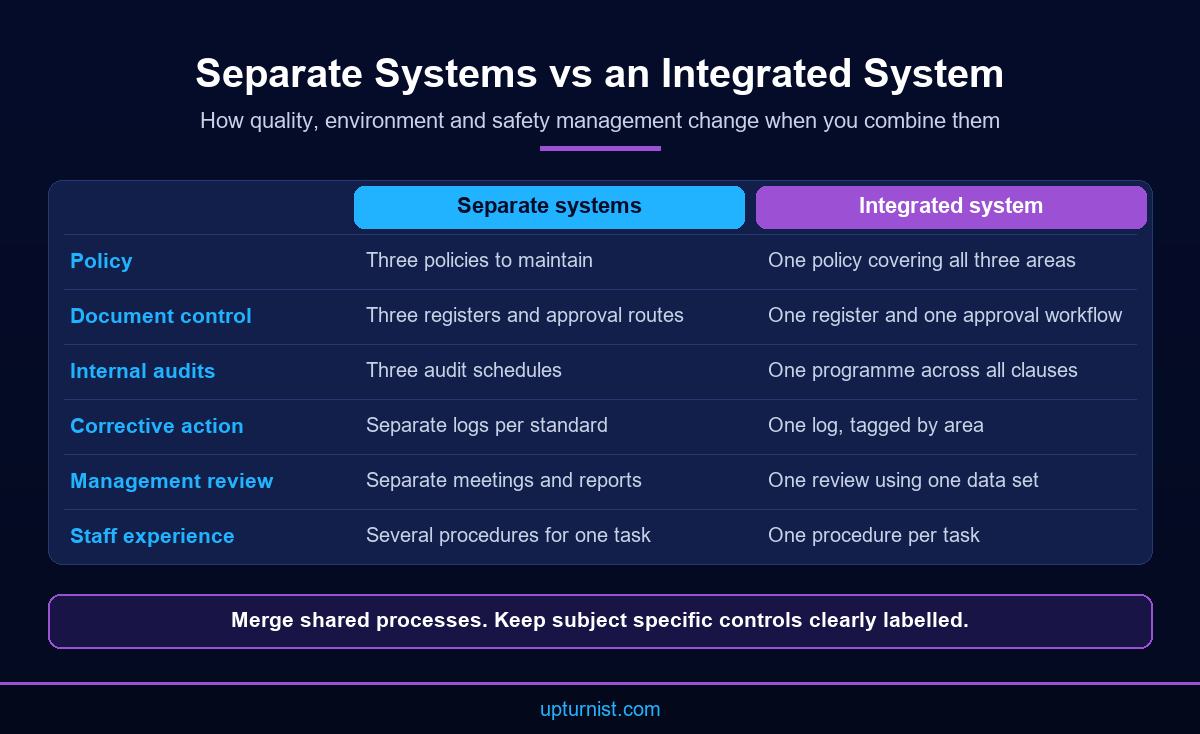
Not everything in an integrated management system should be merged. Shared management processes integrate well, such as document control, internal audits and management review. Subject specific controls often need their own detail, such as environmental aspect registers or hazard assessments. The aim is one system with clearly labelled parts, not one blurred document that nobody can audit.
Elements that usually merge well:
- Policy and objectives. One policy statement covering quality, environment and safety, with objectives for each.
- Document control. One register, one approval workflow and one version history for every procedure.
- Internal audits. One audit programme that checks combined procedures against all relevant clauses.
- Corrective action. One log for non-conformities, incidents and environmental findings.
- Management review. One meeting that looks at all results together.
Elements that often stay distinct include legal registers, aspect and impact assessments, and hazard identification. They still sit inside the same document control and audit cycle. Wikipedia’s summary of ISO 14001 notes that ISO 9001 and ISO 14001 use the same structure, making implementation and auditing more uniform.
A useful test is the front line view. Ask a supervisor to find the procedure for one routine task. If they need three documents to see the quality, environmental and safety steps, integration has not reached the work yet. Well written procedures fix this, which is why many teams begin with structured SOP development.
One Set of Records, Audits and Corrective Actions
The biggest daily gain from an integrated management system is in records. One inspection can check quality, environmental and safety points on the same visit. One corrective action process handles every finding. One dashboard shows the status of all three areas, so managers stop reconciling separate spreadsheets before every review meeting.
Digital tools make this practical. In the quality and ISO compliance project for an oil and gas company in the UAE, inspectors used ISO based digital checklists with photo evidence. The platform automated corrective action management, non-conformance tracking and audit trails, with dashboards showing compliance across sites.
A separate fuel station HSE inspection project used mobile checklists, escalation workflows and live dashboards for safety inspections across the network. Together, the two projects show the building blocks a combined system needs. A single checklist can tag each item by area, and findings feed one action log labelled as quality, environment or safety.
Records also need clear tags. Each finding should show which standard and clause it relates to, so auditors for any area can filter the evidence they need. Without tags, a combined log becomes hard to audit, and teams drift back to a separate QMS quality management system and safety spreadsheet.
Building an Integrated Management System Step by Step
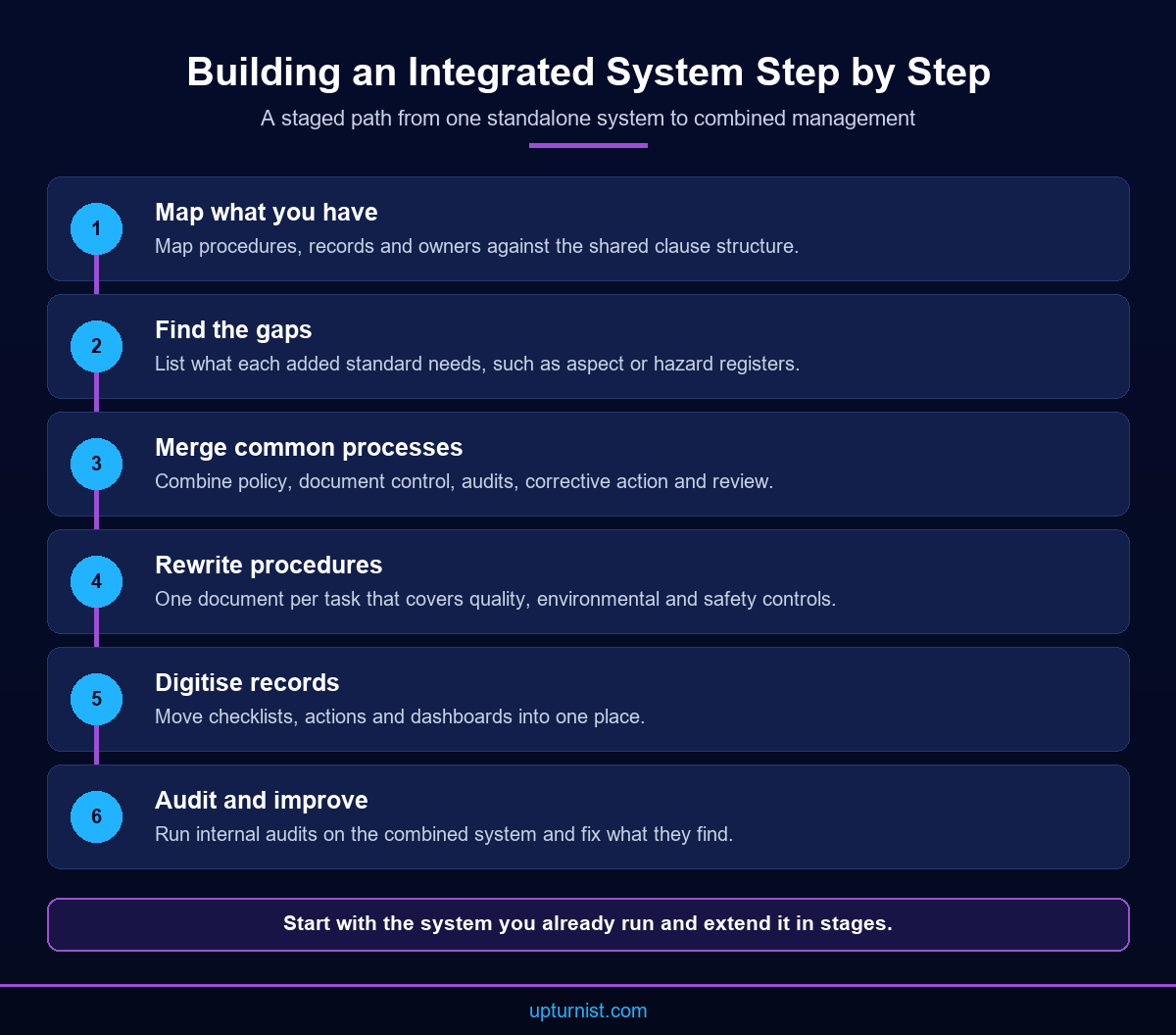
Build integration in stages. Start with the system you already run, map it against the shared clauses, then add the requirements of the next standard. Merge common processes first and keep subject specific controls clearly labelled. Test the combined system with internal audits before you change anything else, so each step is proven before the next.
- Map existing procedures, records and owners against the shared clause structure.
- Identify the gaps for each added standard, such as environmental aspects or hazard registers.
- Merge policy, document control, audits, corrective action and management review.
- Rewrite procedures so one document covers all relevant controls for each task.
- Digitise checklists, actions and dashboards so records stay in one place.
- Run internal audits on the combined system and fix what they find.
Safety is often the last standard added, and it is designed for this. The Wikipedia entry on ISO 45001 explains that it follows the same structure as ISO 9001 and ISO 14001, which makes integration easier. Your procedures should still reflect your real hazards. Our article on writing SOPs that teams actually use covers that drafting step in detail.
Keep the pace realistic. Merging too much at once overloads the people who run the current QMS quality management system. Certification decisions sit with certification bodies, not consultants. The goal is an integrated management system people actually use, not a new binder on the shelf.
Conclusion
Running quality, environment and safety as separate systems multiplies paperwork and confuses the people doing the work. An integrated management system uses the shared ISO structure to run one set of procedures, audits, records and corrective actions, while keeping each standard’s specific controls clear. Upturnist takes a business first, implementation focused approach to this work. Start with what you already have, merge common processes first, and use digital checklists and dashboards to keep records in one place. If you want help designing or digitising a combined system, speak with our consultants about where to begin.
Frequently Asked Questions
What is an integrated management system?
It is one framework that manages quality, environment, and health and safety together. It shares policy, document control, audits, corrective action and management review across standards, while keeping each standard’s specific requirements clearly identified and easy to find.
Which standards are usually combined?
The most common combination is ISO 9001 for quality, ISO 14001 for environment and ISO 45001 for occupational health and safety. They share the same clause structure, which makes combining them far simpler than it once was.
What is the Harmonized Structure?
It is the common framework of clause titles, core text and terms used across ISO management system standards. It covers context, leadership, planning, support, operation, performance evaluation and improvement, so different standards can sit in one system.
Is a QMS quality management system a good starting point?
Often, yes. Many organisations already run a quality system with document control, audits and corrective action. Those processes can be extended to cover environmental and safety requirements, rather than building new systems from scratch.
Does integration mean one manual for everything?
Not necessarily. Many teams keep a short combined manual, or none at all, and rely on well structured procedures and records. What matters is that shared processes run once and subject specific controls stay easy to find.
Can a consultancy certify our integrated management system?
No. Certification decisions are made by certification bodies. Upturnist is a business transformation consultancy that helps you design procedures, digitise inspections and records, and build the dashboards that keep a combined system running well.
How do digital tools help an integrated system?
They keep procedures, checklists, findings and audit evidence in one place. One inspection can cover several areas, one action log handles every finding, and dashboards show status across sites without manually combining spreadsheets.
How should we handle sites spread across the UAE?
Use the same procedures and mobile checklists at every site, with site specific details where needed. Our field operations automation solutions support mobile inspections and digital forms that keep records consistent and comparable across many locations.
Who should own an integrated management system?
Give overall ownership to one senior manager, supported by specialists for quality, environment and safety. Process owners stay responsible for their own procedures. This keeps accountability clear while making sure subject expertise is not lost.