

Fabrication ERP software with job costing compares the estimated cost of each job with its actual cost while the job is still on the shop floor. It records materials, labour, overheads and subcontract work against the job number, so you see margin moving before the final invoice. For steel and metal fabricators, that is the difference between finding a loss at month end and fixing it in week two. This guide explains the cost control workflow step by step, using lessons from a steel manufacturing ERP rollout that Upturnist delivered.
Key Takeaways
- Fabrication ERP software is only as good as the estimate it starts from, so structure every estimate by cost type before you track anything.
- The best ERP software for metal fabrication captures steel issues, labour hours and subcontract orders against the job at the moment they happen.
- A good ERP consultant for steel fabrication companies helps you set variance rules and feed actual costs back into the next quote.
Why Job Costing Decides Margin in Steel Fabrication
Every fabrication job is a small project with its own drawings, materials and deadline. Margin is won or lost inside each job, not across the year. Without job costing, you only learn whether a job made money after it ships. Fabrication ERP software gives you that answer while there is still time to act on it.
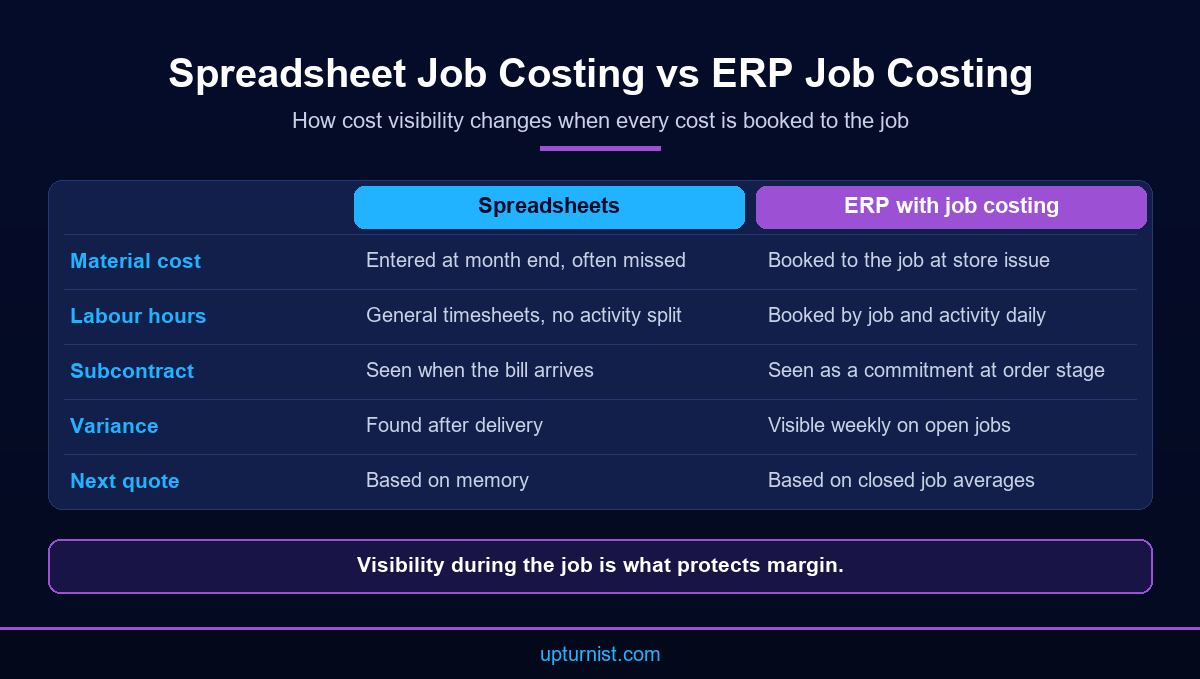
Most fabricators already estimate with care. The gap is what happens after the order is won. Steel leaves the store without a job reference. Welders book hours to a general timesheet. A galvanising bill arrives weeks later and lands in a general expense account. By the time finance pulls it together, the job is closed and the lesson is lost.
The steel manufacturer in our case study faced this problem. Management had limited visibility into estimated cost versus actual project cost. Inventory records were often inconsistent with physical stock. Those two gaps are where most fabrication margins leak, and they are the first things fabrication ERP software should close.
Build the Estimate as Your Cost Baseline
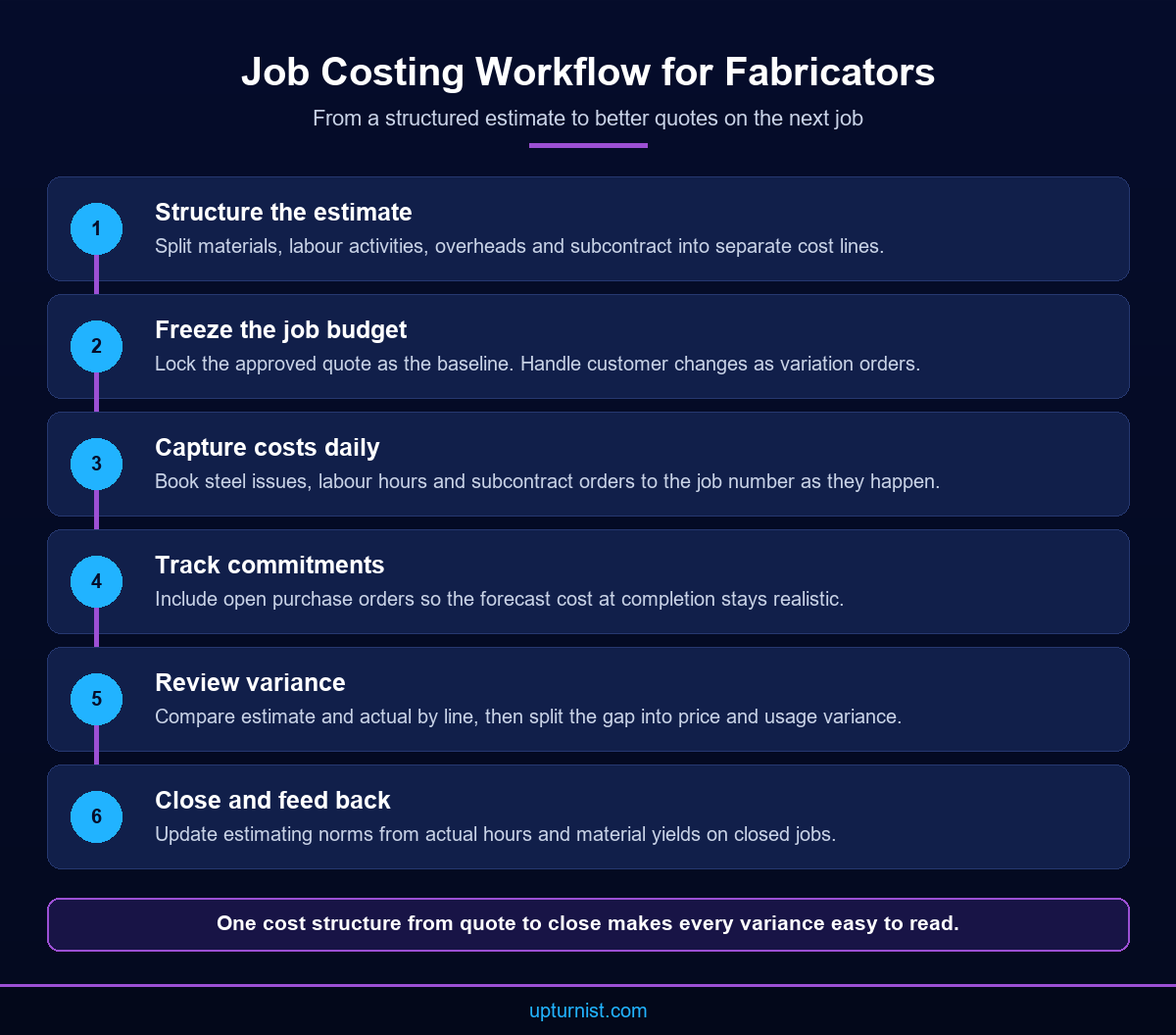
A job cost report is only useful if the estimate is broken down the same way costs will be captured. That means separate lines for each material, each labour activity, overheads and every subcontract package. When the estimate and the actuals share one structure, fabrication ERP software can compare them line by line.
Start from the bill of materials and the drawing register. Price plates, sections, bolts and consumables as separate lines. Split labour into activities such as cutting, fitting, welding, blasting and painting. Give each one estimated hours and a rate. Add overhead as a rate per labour hour or per tonne, and agree which basis your business uses. List subcontract work, such as galvanising or machining, as its own lines with supplier quotes.
Once the customer approves the quote, your fabrication ERP software should freeze it as the job budget. Customer changes become variation orders with their own estimate. That keeps the original baseline clean, so variance reports stay honest.
Capture Actual Costs as They Happen
Actual costs must reach the job on the day they occur, not at month end. Good ERP software for metal fabrication ties every material issue, labour booking and supplier order to a job number. The rule is simple. No cost enters the system without a job, a cost type and an activity attached to it.
- Materials. Issue steel from the store against the job. Return offcuts to stock with their value, so the job is not charged for steel it did not use.
- Labour. Operators book hours to the job and activity from a shop floor terminal or tablet. Supervisors approve the bookings daily.
- Overheads. The system applies them at the agreed rate as labour hours are booked.
- Subcontract. Raise purchase orders against the job, so committed costs show before the bill arrives.
This discipline also fixes inventory. In the steel manufacturing case, connecting procurement, inventory and production on one platform led to improved material planning and reduced inventory mismatches. Upturnist’s manufacturing and industrial solutions connect these steps, so fabrication ERP software reflects the true cost of every open job.
Read the Variance and Act While the Job Runs
Variance analysis, a core part of the job costing method, compares estimated and actual cost for each line and shows where a job is drifting. Fabrication ERP software should report it weekly, or even daily, on open jobs. The point is to act while the job is still running, not to explain a loss after delivery.
Look at variance in two ways. Price variance means you paid more per tonne or per hour than estimated. Usage variance means you used more tonnes or more hours than planned. Price variance is usually a buying or rate issue. Usage variance is usually a drawing, nesting or productivity issue.
Set simple review rules that fit your own history. For example, flag any job whose labour cost runs well ahead of its fabrication progress. Give every alert an owner. Include open purchase orders, so the forecast cost at completion reflects what you have already committed. Then compare that forecast with the contract value to see the projected margin.
What to Check When Choosing Fabrication ERP Software
Not every system handles job costing the way fabricators work. Before you choose fabrication ERP software, test it against your real jobs, not a demo company. Ask whether it can carry your estimate structure, capture costs on the shop floor and report variance without exporting everything to spreadsheets.
Use a short checklist during evaluation:
- Approved estimates convert into job budgets without retyping, and variation orders keep their own budget lines.
- Store issues, offcut returns and purchase orders cannot be saved without a job number.
- Labour booking works on the shop floor, by job and activity, with supervisor approval.
- Overheads apply automatically at the rate you choose.
- Reports show committed, actual and forecast cost at completion for each open job.
- Closed job averages are easy to pull into the next estimate.
Ask each supplier to run one of your recent jobs through the system, from estimate to close. That test shows more than any feature list. Good fabrication ERP software should also be ready to connect with e-invoicing platforms through an API, but cost control comes first.
Quote Better on the Next Job
Job costing pays twice. It protects the margin on today’s job, and it improves the price of tomorrow’s quote. When closed jobs feed real hours per tonne and real material yields back into estimating, the next quote stands on evidence. This is where fabrication ERP with job costing becomes a commercial tool, not just an accounting one.
At job close, run a short review. Compare estimated and actual hours for each activity. Check material yield against the nesting plan. Note any subcontract that came in above its quote. Update your estimating norms from these averages, not from memory.
Patterns appear over time. Some job types always overrun on fitting. Some customers always add late changes. You can price that risk in or decline the work. The company in our UAE engineering ERP case study gained real time visibility into estimation and quotation status, which makes these reviews easier to run. Both case studies used EasyFab ERP, which Upturnist implements. An experienced ERP consultant for steel fabrication companies can help you set the review rhythm, and independent technology consulting lets you test job costing with your own jobs before you commit.
Conclusion
Fabrication ERP software earns its cost when it shows estimated and actual cost side by side on every open job. Build the estimate in the same structure you use to capture costs. Book materials, labour, overheads and subcontract work to the job as they happen. Review variance while there is still time to act, then feed closed job data back into estimating. Upturnist is a business transformation consultancy with a business first, implementation focused approach to ERP. To improve the way you operate and price with confidence, talk to our consultants about your job costing workflow.
Frequently Asked Questions
What is fabrication ERP software with job costing?
It is an ERP system that records every cost of a fabrication job against that job number. It compares actual materials, labour, overheads and subcontract costs with the original estimate, so managers see the margin on each job while work continues.
How is job costing different from standard costing?
Standard costing assigns a fixed cost to repeated products. Job costing tracks the real cost of each unique order. Most fabricators build to customer drawings, so every job differs, and job costing gives a far more accurate view of margin.
Which costs should a fabricator track against each job?
Track four groups: materials such as plates, sections and consumables; labour hours by activity; overheads at an agreed rate; and subcontract work such as galvanising or machining. Keep the same groups in the estimate so comparisons stay simple.
How often should we review job cost variance?
Review open jobs at least weekly, and more often for large or high risk jobs. The goal is to catch overruns while the job is still in fabrication. A monthly review usually arrives too late to change the outcome of the job.
Can job costing improve our quotes?
Yes. Closed jobs give you real hours per tonne, material yields and subcontract prices. Feeding those figures into your estimating norms replaces guesswork with evidence, so quotes become sharper on simple jobs and safer on complex ones.
What causes most variance in steel fabrication jobs?
Common causes include unrecorded material issues, poor nesting yield, extra fitting and welding hours, late customer changes and subcontract bills above quote. Splitting variance into price and usage shows which cause applies to each job.
Do we need to change our processes before implementing an ERP?
Usually, yes. Agree job numbering, cost codes, labour booking and store issue rules first, and the system then enforces them. Upturnist’s enterprise ERP implementation services start with process design before configuration for this reason.
How does job costing help with inventory accuracy?
When every steel issue and offcut return is recorded against a job, stock records stay close to physical stock. In the steel manufacturing case study, the integrated ERP led to reduced inventory mismatches and improved material planning.
Is job costing useful for smaller metal fabrication workshops?
Yes. Smaller workshops often run on thinner margins, so one loss making job hurts more. Even basic job costing on materials and labour shows which work pays. You can add overhead and subcontract tracking as the business grows.